
First Quarter 2026 Review and Commentary
January 9, 2026
Robert Bingham, CFA, President and Chief Investment Officer
John Wright, Principal, Senior Portfolio Manager
Jared Soper, Senior Portfolio Manager
Tyler Waterman, Director of Research, Portfolio Manager
Fourth Quarter 2025 Review and Commentary
“Skepticism and pessimism aren’t synonymous. Skepticism calls for pessimism when optimism is excessive. But it also calls for optimism when pessimism is excessive.”
– Howard Marks, Co-Founder of Oaktree Capital Management
2025 marked another year of above-average market returns as the S&P 500 delivered a total return of 17.9%, driven once again by technology stocks and the Magnificent 7*. The year was not without volatility as investors combatted negative sentiment and risks related to tariffs, trade policy uncertainty, inflation, geopolitical tensions, a weak dollar, cracks in private credit, artificial intelligence (AI) valuation skepticism, a federal government shutdown, spikes in health care premiums, and rising unemployment levels.
Despite these headwinds, total returns were positive in all 11 sectors of the market, with communication services, technology, and industrials outperforming the S&P 500. U.S. stocks demonstrated their resilience with earnings per share growing over 10% as J. P. Morgan observed, “most of the cost of tariffs appear to have been absorbed by U.S. retailers.”
Now that 2025 is in the rearview mirror, investors have begun to focus on the prospects for sustained market momentum in 2026. We put together a list of key themes and our thoughts on the investment outlook over the next 12 months. Ultimately, we see a reasonably high probability that the market performs well as the drivers from last year carry into this year. However, we acknowledge that there are risks to our outlook that need to be considered, which we have also laid out.
Outlook for 2026
- Tax refunds this April from the passage of last year’s One Big Beautiful Bill Act should be stimulative and support consumer spending in the first half of 2026. Internal Revenue Service CEO Frank Bisignano predicted that Americans will receive the “biggest refunds we’ve ever seen” for the 2026 tax season.
- Interest rates should continue to trend lower as Federal Reserve Chair Jerome Powell is likely to be replaced this spring by someone who favors additional rate cuts. The Fed Funds rate was most recently lowered by 25 basis points (bps) to a range of 3.5% to 3.75% at December’s Federal Open Market Committee (FOMC) meeting. The Fed also decided to initiate purchases of shorter-term Treasuries, which will be stimulative in combination with further rate cuts.
- Bond markets should perform well in a declining interest rate environment.
- Oil prices are likely to remain depressed after declining around 20% last year as demand stays muted and efforts are made to bring an end to the Russia-Ukraine war. Lower oil and gasoline prices would help keep inflation low and support the U.S. administration’s desire to see more interest rate cuts. A greater supply of oil shipments from Venezuela after U.S. intervention might further amplify the oil supply-demand imbalance and help to push prices lower.
- Capital expenditures (CAPEX) related to artificial intelligence investment and data center buildouts, driven by large cloud service providers and data center operators (hyperscalers), will remain elevated and drive earnings growth for AI-related companies. A chart of CAPEX growth among the top 5 hyperscalers can be seen below. The figure is expected to increase in 2026, with some estimates exceeding $600 billion.
Hyperscaler Capital Expenditures
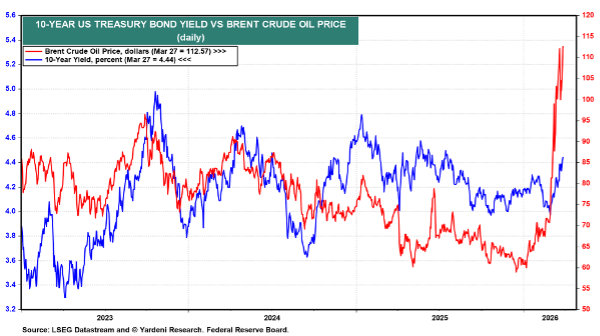
Strategist Ed Yardeni points out that higher oil prices, “shouldn’t heighten inflation as sharply in the U.S. as in Europe since the former is a net exporter of oil and gas while the latter relies on energy imports.” Therefore, while consumer spending may be dampened by higher costs in areas such as gasoline, air fare, and fertilizer, U.S. oil producers stand to benefit from higher prices.
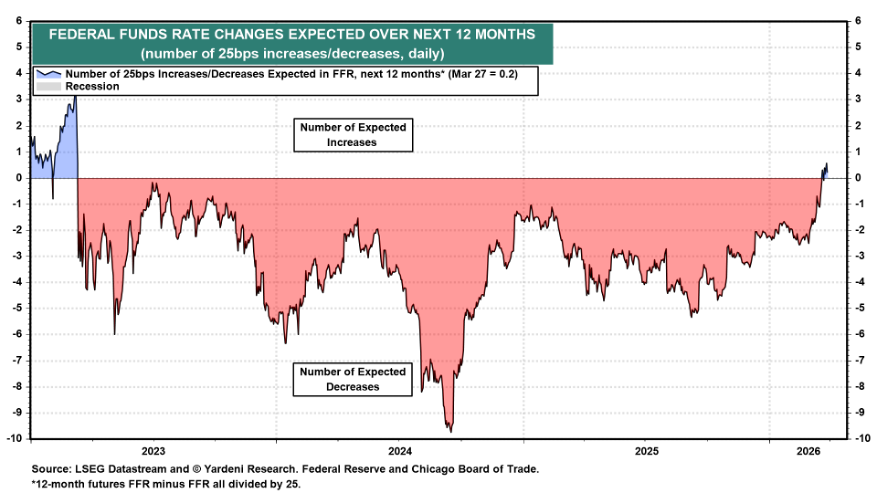
The oil-supply shock that occurred as a result of the closing of the Strait of Hormuz has increased the probability of higher inflation from higher oil prices and thus has lowered the odds of rate cuts this year. The Federal Open Market Committee (FOMC) held the federal funds rate target range steady at 3.50%-3.75% following their March meeting. Market expectations for changes to the federal funds rate have aggressively shifted from two 25 basis-point rate cuts at the start of the year to no cuts at all per the chart below.
Federal Reserve Chairman Jerome Powell was asked at a press conference if there had been any discussion about the risk of stagflation, which is an economic environment characterized by low economic growth, high unemployment and high inflation. Mr. Powell responded that the term, “stagflation…was a 1970s term at a time when unemployment was in double figures, and inflation was really high…and that’s not the case right now. We actually have unemployment really close to longer run normal, and we have inflations that’s… 1 percentage point above that.”
In addition to volatility fueled by geopolitics, the market saw a rotation out of the Magnificent 7 and growth stocks and into value stocks as evidenced by the outperformance of the equal-weighted S&P 500 Index during the first quarter when compared to the market-cap weighted S&P 500 Index. The S&P 500 had a total return of -4.4% through March 31st while the equal-weighted S&P 500 was up 0.7%.
The Russell 2000 also eked out a slight gain of 0.9% while the Nasdaq declined 7%, both including dividends. Gold continued its hot streak from the prior year, finishing the quarter up over 8%, though well off its peak of over $5,500 per ounce in late January.
In the technology sector, software companies, like Microsoft and Salesforce, underperformed dramatically in the quarter due to fears that advancements in agentic artificial intelligence (AI) would cause disruptions and lead to fewer sales of licensed user accounts (aka seats). Investors are worried that AI tools will enable software users to be more efficient, thus requiring a smaller workforce to get the same amount of work done.
The AI startup Anthropic, which competes with OpenAI, was the cause of several headline-driven selloffs in software stocks due to the release of highly sophisticated tools in the enterprise software space. Claude Code, which facilitates programming tasks, and Claude Cowork, an agentic AI feature that acts as an autonomous assistant, are two flagship products from Anthropic that are expected to make workers more productive.
Stocks in industries such as legal, data services, financial analytics and cybersecurity were pressured after various announcements from Anthropic throughout the quarter. While it still may be too early to tell who the winners and losers will be among software-as-a-service (SAAS) providers, J.P. Morgan writes that we should consider whether AI is a threat to the product’s moat: “Deeply embedded, data-rich, mission-critical software is safer. Generic, labor-scaled, or easily replaced tools are at risk. Seat based revenue models are more at risk than usage based.”
While investors are hitting the sidelines and awaiting more clarity on the Iran war timeline, inflation expectations, AI disruption, and mid-term election results – analysts are expecting corporate earnings to grow around 14% in the first quarter, which is just about in-line with the prior quarter. Magnificent 7 companies are once again expected to outpace the rest of the S&P 500, with first quarter earnings growth consensus of around 24.2% versus 10.3% earnings growth for the other 493 companies that comprise the index.
Equity valuations have become more reasonable since the start of the year, with the S&P 500 price to earnings multiple contracting from over 22 in January to around 20 in early April, driven by the technology sector’s selloff.
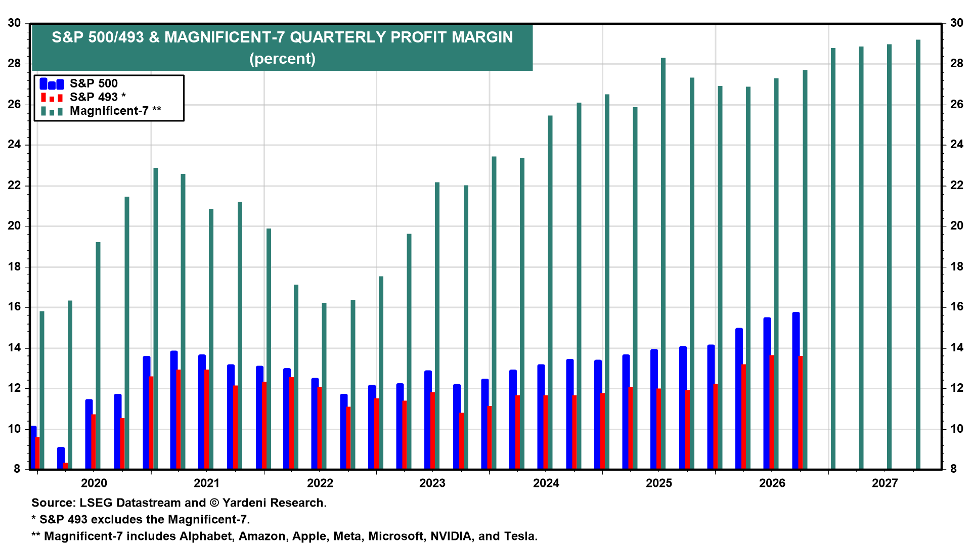
The current market correction combined with an outlook for continued margin expansion, highlighted in the chart above, provides an opportunity to slowly and strategically add to growth stocks for those with a long-term time horizon. Oil prices are likely to remain elevated until the Strait of Hormuz is fully opened and oil infrastructure in the Middle East is repaired, but any positive developments will be well received as the market is forward-looking.
In periods of heightened geopolitical tension and rapid technological shifts, investors’ natural impulse is to react to headlines. However, our focus remains on the underlying fundamentals, such as earnings growth and margin expansion. While the path through the remainder of 2026 remains clouded by the conflict in the Middle East and the evolution of AI, we believe a disciplined approach that balances high-quality growth with defensive positioning is the most prudent way to navigate this volatility. As always, we are monitoring these developments closely and remain committed to your long-term financial objectives.
Please don’t hesitate to reach out if you would like to schedule a meeting to review your accounts or discuss your goals for the coming months. In the meantime, we hope you all enjoy the warmer spring weather.
Securities noted above valued as of the market close on April 10, 2026:
Alphabet Inc. Class C (GOOG $315.72)
Amazon.com Inc. (AMZN $238.38)
Apple Inc. (AAPL $260.48)
Meta Platforms Inc. (META $629.86)
Microsoft Corp. (MSFT $370.87)
NVIDIA Corporation (NVDA $188.63)
Salesforce, Inc. (CRM $164.96)
Tesla Inc. (TSLA $348.95)
These summary/prices/quotes/statistics contained herein have been obtained from sources believed to be reliable but are not necessarily complete and cannot be guaranteed. Errors and omissions excepted.
This is not a general recommendation to buy or sell any particular security. Such advice is given to each of our clients individually based on their particular financial goals and objectives, risk tolerance and investment experience. For advice regarding your individual portfolio, please contact your investment manager. The information displayed here is limited to the dissemination of general information on products and services and transactions cannot be completed via this website.
The charts included in this report are sourced from Yardeni Research.
